
Try a career.
A mission puts you in front of a problem you could meet in the field. You discover what the work feels like by doing it.
INNOVATECH JOURNAL · OUR METHOD
A challenge that puts you in motion. People who question your work. Useful learning at the right time. Here’s how experience can become a skill.
UNDERSTANDING THE MODEL
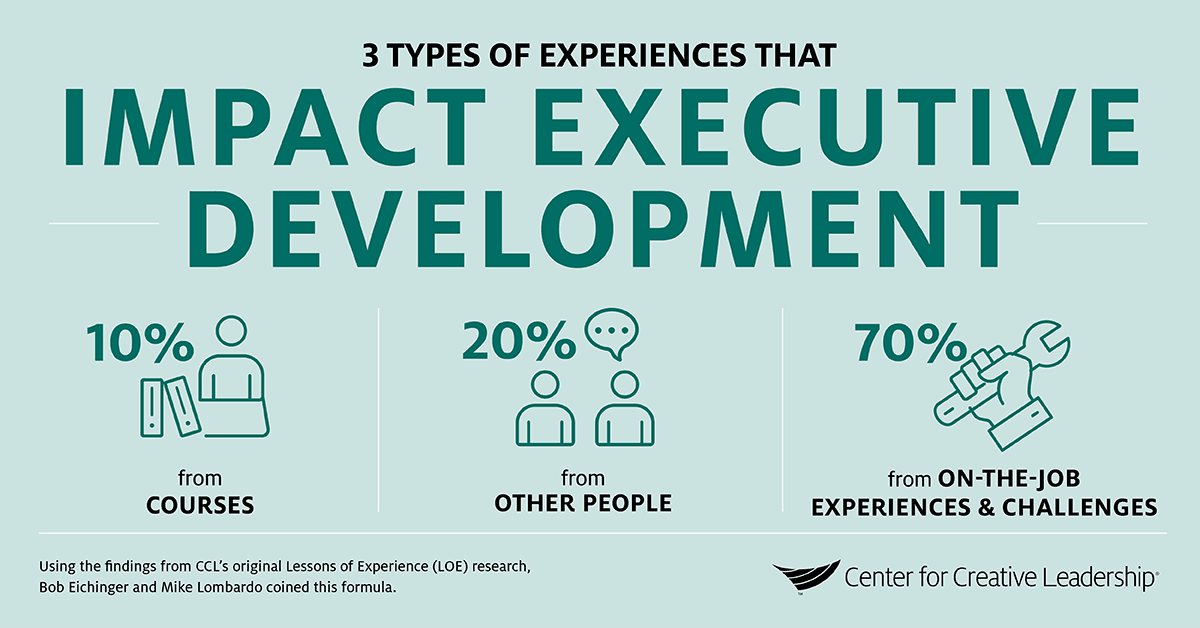
The Center for Creative Leadership describes three complementary sources of development: challenging experiences, developmental relationships, and formal learning. These ideas are often summarized as the 70–20–10 model.
The model comes from research into leadership development. At INNOVATECH, we use it as inspiration for career exploration—not as a formula that measures every learner’s progress.
A GUIDE, NOT A RECIPE
The point is not to measure every minute. It is to let experience, feedback, and focused learning strengthen one another.
Experience
Step into a new field with a real problem to solve. Explore data, test ideas, and make a decision. You’re not memorizing someone else’s answer: you’re building your own.
Learning with others
An expert challenges your choices, asks how you reached a conclusion, and gives you practical feedback. You spot what you might have missed, then improve your work.
Focused learning
Theory becomes useful when a question comes up in your work. A concept, resource, or workshop helps you move forward exactly where you need it.
WHY FOCUSED LEARNING MATTERS
A useful resource can name something you just noticed, correct a misunderstanding, or help you make a better decision. It sticks because you already know why you need it.
WHAT THIS LOOKS LIKE AT INNOVATECH
A mission puts you in front of a problem you could meet in the field. You discover what the work feels like by doing it.
Data and AI help you explore. The decisions, checks, and recommendations are still yours.
After expert feedback and another iteration, your deliverables and skills can be collected in your Skill Passport.
THE INNOVATECH APPROACH
Every step makes the next one more useful. At the end, you don’t only say “I learned”. You can show what you analyzed, decided, and built.
Find my missionThis original INNOVATECH article is informed by the Center for Creative Leadership’s 70–20–10 research and article. The infographic is credited to CCL and linked to its original source.